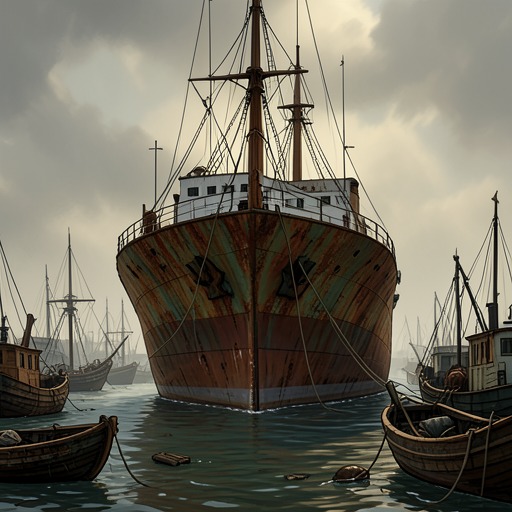
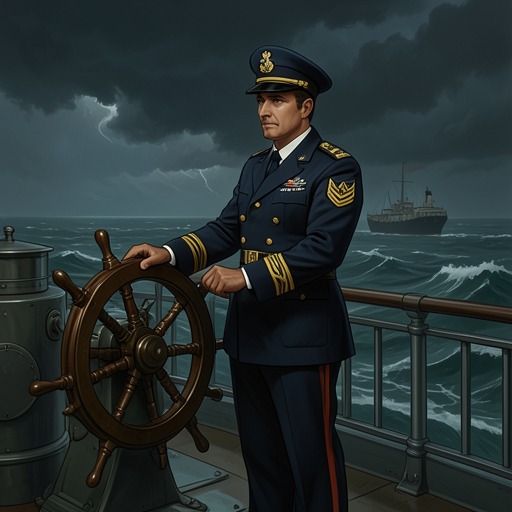
Kamikaze attack on USS Caine
The Caine MutinyThe kamikaze attack on USS Caine is a turning point in Willie Keith’s service, remembered less through an operational account of the strike than through what followed: a fire he helped extinguish, a medal, and evidence used to support his promotion to captain. The novel presents the episode as a perilous wartime action whose consequences lasted into Keith’s later command and personal life.
The Attack and Its Record
The supplied account identifies the incident as a kamikaze or suicide attack and connects it to a fire aboard USS Caine. It does not specify the date, location, course of the attack, or the full sequence of the ship’s response. The event’s significance is instead conveyed through later accounts: Tom Keefer tells a superior that Keith saved the ship during the disaster, while the Navy’s citation recognizes Keith for putting out the fire after the attack.
That difference in emphasis matters. The attack itself is not reconstructed here in tactical detail; the surviving narrative traces its effects through testimony and recognition. Keefer’s account presents Keith’s action as consequential to the ship’s survival, and the official citation gives that service institutional acknowledgment.
Recognition and Command
Keefer invokes Keith’s conduct when the question of recommending officers for relief arises. He identifies Keith as a candidate for the Navy Cross and relates that he saved USS Caine during the kamikaze disaster. The superior responds that Keith sounds capable of handling command and agrees to send the dispatch. Three days later, an action message reaches the ship: Keith has been made captain. The episode thus becomes part of the practical case for entrusting him with command, not merely a commendable act in isolation.
A separate letter from the Bureau of Personnel brings Keith a Bronze Star in a small maroon box. Its citation praises him for putting out the fire after the suicide attack and describes his heroism as exceeding the call of duty. Keith sits with the medal for several minutes before continuing through his official mail. The award makes his service publicly legible in a formal record, while the command recommendation shows how the same action bears on his responsibilities aboard ship.
Retelling and Personal Meaning
Later, Keith tells May Wynn how he nearly died in the kamikaze attack. The novel gives no further operational detail in this recollection; its focus is on the act of telling and on May’s response. Keith shows her the Bronze Star and offers it to her. Her admiration gives the medal a meaning beyond its official citation: it becomes something he can share with the person to whom he has returned, though he frames the gesture as the only good he expects to come from it.
The episode therefore recurs in distinct forms: as a shipboard emergency, as evidence in a command decision, as an official award, and as a story Keith tells May. Across those returns, the emphasis shifts from danger to duty and then to intimate recognition. His survival and service are not presented solely as a private achievement; they become part of his standing as an officer and of the history he brings back to May.
Fictional and Historical Status
The novel’s prefatory note explicitly identifies the Caine and all events aboard it as fictional. It also cautions that operational times, places, ship names, missions, and naval procedures have been altered for the story or to avoid disclosing classified information, and states that no ship named USS Caine existed. The kamikaze attack and Keith’s award should therefore be understood as elements of the novel’s fictional wartime history, not as a documented incident involving an actual vessel.